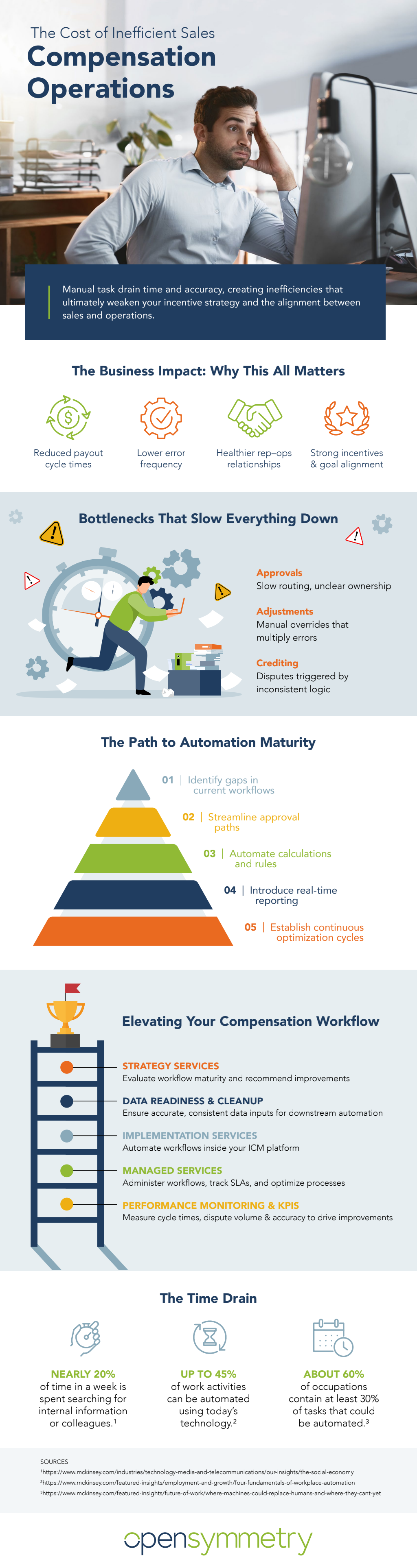
Compensation programs play a central role in how organizations motivate performance, guide behavior, and reinforce strategic priorities. When the processes behind these programs rely on outdated methods, the impact reaches far beyond delayed payouts or occasional inaccuracies. Inefficient compensation workflows interrupt the flow of information, complicate decision-making, and place a growing burden on teams that should be focused on supporting revenue and growth.
Many organizations begin with simple tools because they appear flexible and familiar. Over time, these tools evolve into sprawling spreadsheets and disconnected routines that depend heavily on tribal knowledge. What starts as a manageable process becomes difficult to maintain as the business grows. Each new product line, territory, crediting rule, or exception adds another layer of complexity. As a result, teams spend increasing amounts of time locating the right inputs, confirming the latest plan rules, or interpreting exceptions that are not documented consistently.
This type of environment puts pressure on collaboration across sales, finance, HR, and operations. When information moves slowly or is interpreted inconsistently, teams find themselves working reactively instead of proactively. Leaders lose visibility into current performance and are unable to rely on the data needed for timely decisions. Employees who depend on accurate and predictable compensation begin to question whether the process supports their efforts or holds them back. Trust becomes fragile in these conditions, and small errors can have significant cultural effects.
The challenge is not simply the volume of work involved. Manual workflows lack the structure required to ensure a repeatable and auditable process. Without standardization, organizations struggle to enforce plan rules, validate credits, or track the history of adjustments. These gaps create risk from both an operational and compliance perspective. They also limit the ability to analyze what is working within a plan and what needs refinement. A strong compensation program requires more than accurate payouts. It requires a foundation that connects technology, governance, and plan strategy.
A modernized workflow transforms compensation from a task to a strategic system. When organizations adopt automated processes, they gain more than efficiency. They gain clarity, consistency, and confidence in the data that drives business decisions. Stakeholders are able to collaborate more effectively because information moves in a predictable and transparent manner. Leaders can assess performance in real time and adjust their strategies with greater agility. Reps feel supported by a process that honors their efforts and rewards them fairly.
Organizations that invest in improving compensation workflows position themselves for stronger alignment, better insights, and a healthier performance culture. Manual processes eventually reach a point where they limit growth. Modern workflows allow organizations to scale without sacrificing accuracy or trust.
For expanded insights into the impact of compensation workflow improvement, refer to the accompanying resource from OpenSymmetry, a provider of SPM assessments.